
Sword Health: AI Care
Sword HealthMedical
4.71.18K Reviews
- Version
- 8.7.0
- Installs
- 100.00K
- Age Rating
- Everyone
Screenshots
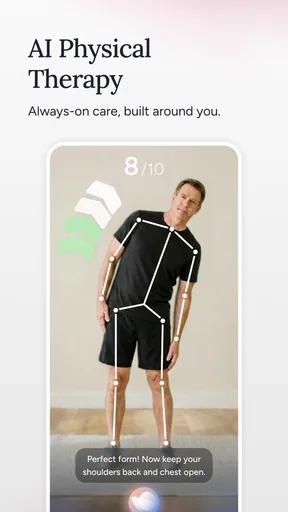
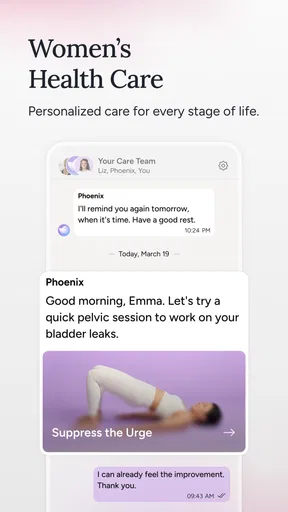
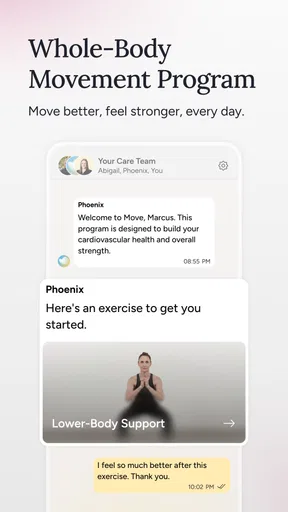
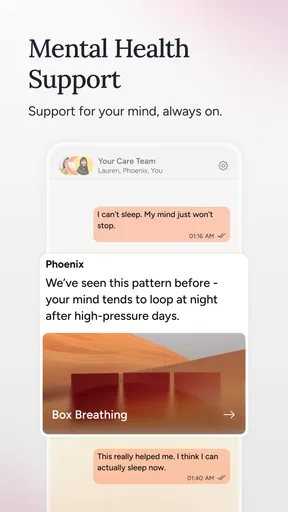
Our Review of Sword Health: AI Care
 Analysis by Appyee
I came away from Sword Health: AI Care with a fairly clear impression: it is most useful as a structured companion for people who want help staying consistent with movement and recovery, not as a replacement for a clinician. That distinction matters in medical apps, where a polished interface can easily create more confidence than the product deserves. Sword Health, developed by Sword Health, presents itself as a better way to feel better, but its real value depends on whether you will actually follow a guided routine and use the app as part of a broader care plan.
As a free medical app for Everyone, it is easy to try without turning the decision into a financial commitment. Its public reception is also encouraging, with a 4.8 average from around nine thousand ratings and over one hundred thousand installs. Those figures suggest that many people find the experience worthwhile, although they cannot tell you whether it suits your particular condition, mobility level, or expectations.
What using Sword Health: AI Care feels like in everyday life
The first thing I noticed is that this is not the same proposition as opening a general exercise video platform and searching for “back pain stretches.” A conventional video library gives you variety, but it also leaves you responsible for choosing the right routine, judging your form, and deciding when to progress or stop. Sword Health: AI Care is designed around a more focused healthcare experience, where guidance and regularity matter more than an endless catalogue of workouts.
That focus is its strongest argument. When pain or reduced mobility makes exercise feel uncertain, too much choice can become another obstacle. A person may save several videos, try one for a few days, then abandon the plan because it is difficult to know whether the routine is appropriate. A dedicated app can make the process feel more manageable by giving the user a clearer path instead of asking them to become their own program designer.
I would approach it as a tool for building a repeatable habit. The useful question is not whether one session makes you feel dramatically different. The better question is whether the app helps you perform appropriate movement regularly, notice how your body responds, and communicate more clearly about that experience when professional care is involved.
That last point is important. A medical app can support self-management, but it should not be treated as an authority for every symptom. New, severe, rapidly worsening, or unusual pain deserves proper medical attention. Sword Health: AI Care may fit into that process, but it should not delay it.
The practical strength is structure, not spectacle
Many health applications try to motivate users with gamification, dramatic progress language, or a huge number of exercise options. Sword Health takes a more serious route. The appeal is the feeling that your recovery work has a place and a purpose, rather than being an improvised collection of movements.
For me, the most convincing use case is someone who knows they should move more but struggles to turn that intention into a routine. This could be a person returning to normal activity after a period of stiffness, someone managing recurring discomfort, or an office worker who needs a consistent approach to mobility instead of occasional bursts of enthusiasm. The app is especially relevant when the main problem is follow-through.
A realistic example would be a user who spends most of the day at a desk. By late afternoon, their back or neck feels tight, and they usually respond by searching for a quick video. With Sword Health: AI Care, the better workflow is to reserve a regular moment for the guided work, use the session as a deliberate break, and pay attention to whether the movements feel helpful, neutral, or aggravating. That creates a simple feedback loop: routine, observation, and adjustment.
The non-obvious benefit here is psychological rather than technical. A defined session reduces the mental effort of deciding what to do. That can be more valuable than adding another advanced feature, especially for people who are tired, uncomfortable, or worried about making the wrong choice.
Where it compares well with ordinary alternatives
Compared with generic stretching videos, the app has a clearer medical identity. A video platform may be better for browsing, entertainment, or learning a wide range of activities, but it is not necessarily designed around a user who wants a more deliberate care experience. The trade-off is that a video platform can feel more flexible and less formal, while Sword Health: AI Care is likely to appeal to people who want boundaries and direction.
Compared with visiting a physical therapist in person, an app is more convenient and easier to fit around work, family, or travel. It can help fill the gap between appointments or support someone who needs reminders to keep working on movement. It cannot, however, offer the same hands-on assessment, direct observation, or immediate clinical judgment that an in-person professional can provide.
Compared with a basic habit tracker, Sword Health: AI Care should be more relevant to the actual movement process rather than merely recording whether you completed a task. A habit tracker may be preferable for someone who already has a clinician-approved routine and only needs reminders. The Sword approach makes more sense when the user wants a healthcare-oriented framework, not just a checkbox.
Compared with paid digital coaching, the free price removes one important barrier to experimentation. That makes it easier to see whether this style of support fits your routine before committing to a service. Still, free access should not be confused with unlimited suitability. The right question is whether the guidance matches your needs, not simply whether it costs nothing.
Small workflow choices that can make the experience better
I would not install this app and wait for motivation to appear. I would decide in advance when it belongs in the day. A session placed after brushing your teeth, before lunch, or immediately after finishing work has a better chance of becoming automatic than one left for “whenever there is time.” The app can provide structure, but the user still has to protect the appointment with themselves.
I would also keep a short personal note after each session. It does not need to be elaborate. Recording whether the routine felt easier, unchanged, or more uncomfortable helps prevent vague impressions from controlling the whole decision. This is a useful habit because short-term sensations can be misleading, and a pattern over several sessions is more informative than one unusually good or bad day.
Another practical tip is to treat discomfort as information, not as a challenge to overcome. People often assume that a difficult movement must be effective. In a medical setting, that is a risky shortcut. If something feels wrong, I would stop, reassess, and seek professional advice rather than pushing through simply to complete the session.
Finally, I would use the app as a conversation aid. If you already see a doctor, therapist, or other qualified professional, describing which movements were comfortable or difficult can make the appointment more useful. That turns the app from a solitary screen activity into one part of a more informed care routine.
The meaningful limitations you should accept
The biggest limitation is inherent to app-based care: a phone cannot fully understand your body in the way an experienced clinician can. Even when an app offers guidance, it may not recognize every compensation, hesitation, or subtle change in movement. Users who need hands-on correction or a detailed diagnosis should choose professional assessment first.
There is also a commitment problem. A structured program only helps when the user returns to it. Someone who downloads health apps enthusiastically but rarely completes them may find that Sword Health: AI Care becomes another abandoned icon. The free price makes trying it easy, but it also makes quitting easy. The app cannot solve inconsistent follow-through on its own.
Some users may also prefer the freedom of creating their own routine. If you already have clear instructions from a clinician and feel confident performing them, a simpler tracker or calendar reminder may be less intrusive. Sword Health: AI Care is not automatically better just because it is more specialized; specialization is useful only when it reduces uncertainty rather than adding another layer to your day.
Privacy and comfort with medical technology are practical considerations too. Anyone using a health app should take time to understand how they feel about entering personal information and relying on digital guidance. I would not rush through setup merely to reach the first session. A few minutes spent reading the app’s own explanations and settings can make the experience feel more controlled.
Another limitation is expectation management. The store summary, “A better way to feel better,” is appealing but broad. No app can promise that every user will improve in the same way or at the same pace. If you expect instant relief, a diagnosis, or a complete answer to a complicated condition, this is probably the wrong tool. If you expect practical support for a consistent care routine, the proposition is more reasonable.
Who is most likely to benefit
I would recommend trying it to adults who want a guided, healthcare-focused way to work on movement and who are willing to make regular practice part of their schedule. It may be particularly suitable for people who feel overwhelmed by generic exercise content, need a nudge to stay consistent, or want something more purposeful than a standard reminder app.
It is also a sensible option for someone who wants to explore digital care without paying at the outset. Because the app is free and rated for Everyone, the initial barrier is low. That does not mean every exercise or recommendation is right for every person, so I would still match the experience to your own medical situation and ask a professional when there is uncertainty.
I would be more cautious about recommending it to someone with a serious injury, unexplained symptoms, major movement restrictions, or a condition requiring close supervision. In those cases, an in-person clinician or a service with direct professional involvement may be a better first step. The same applies to anyone who finds app instructions confusing or who cannot tell whether a movement is being performed safely.
People who dislike scheduled routines may also struggle. The app’s value comes from turning care into a repeatable practice, so users looking only for occasional inspiration may not get much from it. On the other hand, if your problem is that you keep postponing the work you already know you need to do, its structure may be exactly what you are missing.
My verdict after weighing the trade-offs
Sword Health: AI Care makes the strongest case for itself as a practical bridge between professional advice and daily follow-through. It is more purposeful than a random search for exercise videos and more relevant to movement care than a plain habit tracker. Its free availability makes experimentation straightforward, and its strong user reception gives it a reassuring starting point.
My recommendation comes with a boundary: use it to support care, not to replace judgment. The app is at its best when you are willing to practice consistently, observe your response, and involve a qualified professional when symptoms do not make sense. It is less suitable for urgent problems, complex conditions, or anyone expecting a screen to provide a complete clinical assessment.
For the right person, the real improvement may be surprisingly simple: fewer decisions, a clearer routine, and a better way to keep movement from disappearing into the background of the day. That is not a miracle cure, but it is a meaningful strength. If you want structured support for everyday recovery work rather than a generic exercise catalogue, Sword Health: AI Care is worth trying—with realistic expectations and attention to your own safety.
The app was released on August 9, 2019, and remains a recognizable option in the medical category. With over one hundred thousand installs and around one thousand one hundred written reviews, it has built a substantial user base without requiring an upfront purchase. I would choose it for guided consistency, compare it with professional care whenever the situation is complicated, and skip it if what I really needed was diagnosis, hands-on correction, or urgent medical help.
Privacy and Permissions
See what permissions an app requests and how it handles your data.
- Calendar
- read calendar events plus confidential information, add or modify calendar events and send email to guests without owners' knowledge
- Location
- approximate location (network-based), precise location (GPS and network-based)
- Phone
- read phone status and identity
- Photos/Media/Files
- read the contents of your USB storage, modify or delete the contents of your USB storage
- Storage
- read the contents of your USB storage, modify or delete the contents of your USB storage
- Camera
- take pictures and videos
- Microphone
- record audio
- Wi-Fi connection information
- view Wi-Fi connections
- Device ID & call information
- read phone status and identity
- Wearable sensors/Activity data
- body sensors (like heart rate monitors)
- Other
- view network connections, pair with Bluetooth devices, access Bluetooth settings, send sticky broadcast, full network access, change your audio settings, run at startup, draw over other apps, control vibration, prevent device from sleeping
Verdict
Strengths of Sword Health: AI Care
- Personalized digital physical therapy plans guided by AI.
- Motion tracking helps users perform exercises with better form.
- Convenient home-based sessions reduce the need for clinic visits.
- Progress tracking can help users stay motivated and consistent.
- May support recovery for several common musculoskeletal conditions.
Limitations of Sword Health: AI Care
- Requires compatible devices and adequate space for exercise sessions.
- Some features may depend on an active subscription or insurance coverage.
- AI guidance cannot fully replace hands-on assessment by a clinician.
- Camera-based tracking may be affected by poor lighting or positioning.
- Availability and eligible treatment plans can vary by location.
Similar Picks in This Category
View All
WebMD: Symptom Checker
WebMD, LLC4.1

Microphone Amplifier
DOSA Apps4.2

Anatomy Learning - 3D Anatomy
3D Medical OU4.5

Period Tracker and Calendar
SimpleInnovation4.9

GoodRx: Prescription Coupons
GoodRx4.8

CVS Health
CVS Pharmacy4.5
Frequently Asked Questions
What is Sword Health: AI Care, and how does it work?
Sword Health: AI Care is a digital health platform designed to support people with musculoskeletal conditions such as back, neck, joint, and muscle pain. It typically combines guided exercise therapy, educational content, progress tracking, and feedback from a care team. Depending on your plan and location, the app may use motion-tracking technology or connected devices to help monitor exercise form and encourage consistent rehabilitation at home.
Is Sword Health: AI Care suitable for everyone with pain or mobility problems?
The app may be helpful for many adults managing common musculoskeletal issues, but it is not a universal replacement for medical care. Suitability can depend on your diagnosis, symptoms, physical ability, treatment goals, and access through an employer or health plan. Before beginning exercises, especially after an injury or surgery, users should follow the guidance of a qualified healthcare professional and contact a doctor if symptoms are severe or unusual.
Do I need special equipment or a subscription to use Sword Health?
Requirements can vary according to the program available to you. Some Sword Health plans may provide or require a dedicated sensor kit, while other features can be accessed using a compatible smartphone or tablet. The service is often offered through participating employers, insurers, or healthcare programs rather than as a completely open consumer subscription. Check your eligibility, device compatibility, pricing, and any equipment terms before downloading.
Can Sword Health replace in-person physical therapy or a doctor’s appointment?
Sword Health is intended to complement professional healthcare by providing structured support and remote guidance, not to replace emergency treatment, diagnosis, or every form of in-person physical therapy. Its digital format can be convenient for completing exercises at home and communicating with a care team, but some conditions require hands-on assessment, imaging, specialist care, or supervised treatment. Seek medical attention promptly for serious pain, weakness, numbness, or sudden changes.
What privacy and account information does Sword Health require?
Because Sword Health is a digital healthcare service, it may request personal details, health information, treatment goals, exercise data, and device or activity information needed to deliver and personalize care. The exact data collected depends on the features and program you use. Before registering, review the app’s privacy policy, consent screens, data-sharing practices, and account deletion options, particularly if access is provided through an employer or insurance partner.
